The gene linked to dyslexia has been identified, which could lead to better treatment for millions of dyslexics scientists said today.
Findings from a team at Oxford University showed that early identification of the gene in young children could help them cope with the condition.
Dr Silvia Paracchini, from the Wellcome Trust Centre for Human Genetics at Oxford, said: 'On average, people carrying this common genetic variant tended to perform poorly on tests of reading ability.
'However, it is important to note that this is only true for reading ability and not for IQ, so it doesn't appear to be connected to cognitive impairment.'
The study was based on 6,000 British children aged between seven and nine and part of a wider investigation that has been monitoring the health and development of 14,000 mothers and their children for the past 18 years.
Scientists say it was already known that a particular DNA pattern was linked to reduced activity during development in the womb. The mutation affects the cerebral cortex, the section of the brain responsible for thought processes.
Professor Margaret Snowling, vice president of the British Dyslexia Association, said: 'The finding of a gene associated with reading ability in the general population as well as in dyslexia is in line with our observation that there are degrees of dyslexia from mild to severe. It also implies that there are other genes or environmental experiences that must be involved in determining reading ability.
New York Times Article:
The September 7th, 1999 article in the New York Times (the abstract of which can be viewed via the link at the bottom of the page) describes the discovery. Dr. Toril Fagerheim of the University Hospital of Tromsoe, Norway, in conjunction with the University of Antwerp in Belgium and the University of Florida in Miami, is credited with the discovery of the gene. (AP, 1999)
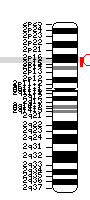
The article states, essentially, that through an analysis of a large Norwegian family's pedigree, Dr. Fagerheim was able to find the Dyslexia gene. The gene has been mapped to the second chromosome and is referred to as DYX3. Neither the pathway by which the gene acts nor the name and type of protein that the gene codes for are mentioned. According to Dr. Fagerheim, "cloning of the DYX3 gene will provide insight into the nature and frequency of at least one gene that is involved in reading and spelling," implying that there quite probably could be more than one gene involved in the Dyslexia pathway. She also states that Dyslexia is composed of both genetic and environmental components. (AP, 1999)
Scientific Article:
The scientific article entitled "A new gene (DYX3) for dyslexia is located on chromosome 2" (the abstract of which is linked at the bottom of this page) describes the history of the search for the dyslexia gene and the location that was discovered in the recent linkage analysis of a large Norwegian family. The location specified is the second chromosome, between p15 and p16. The article states that the actual gene has not yet been isolated but, that isolation of the gene will provide "new and exciting insights into the processes involved in reading and spelling." (Fagerheim, T., et. al., 1999)
No comments:
Post a Comment
thank you for your post dyslexiamylife.org
info@theglp.org